
Tavapadon (Juvmo): What Parkinson’s Patients and Families in India Want to Know
The 60-second version
- What it is: Tavapadon, brand name Juvmo (AbbVie), is a once-daily tablet for Parkinson’s disease. It is the first approved medicine that switches on only the D1/D5 family of dopamine receptors.
- What it does: It treats movement symptoms. It can be used alone in early Parkinson’s, or added to levodopa in people whose medicine wears off.
- What it does not do: It has not been shown to slow or stop the disease. It is not a cure.
- Where it stands: Approved by the US FDA in late September 2026, with US availability expected from October 2026.
- India: [At the time of writing the product is not launched in India – October 2026] Please do not stop, change or add any Parkinson’s medicine on the strength of this page.
Part 1: The basics
Why is everyone talking about tavapadon?
Because new types of Parkinson’s tablets are rare. Levodopa, the mainstay of treatment, dates back to the 1960s, and the dopamine agonists many patients take (pramipexole, ropinirole, rotigotine) all work on the same receptor family. Tavapadon takes a different route. The company describes it as the first dopamine-based breakthrough in decades, and neurologists have called it the first new class of dopamine agonist in a long time. That is enthusiasm worth taking seriously, but not at face value. See Part 3.
What is tavapadon, in plain language?
Parkinson’s happens because the brain cells that make dopamine, a chemical messenger that smooths movement, gradually die. Medicines help by topping up or imitating dopamine.
Tavapadon imitates dopamine. It was originally developed at Pfizer, later taken forward by Cerevel Therapeutics, and came to AbbVie when AbbVie acquired Cerevel in 2023.
What is special about its mechanism?
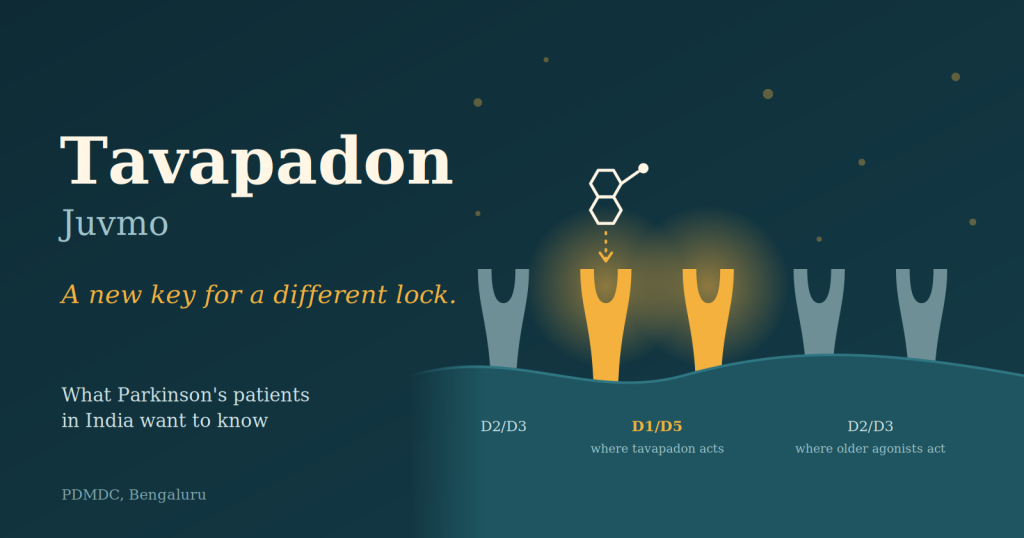
Dopamine docks onto several “locks” (receptors) in the brain. Think of two groups:
- D2/D3 receptors: the target of today’s dopamine agonists. Switching these on helps movement, but is also linked to nausea, sleepiness, swelling, hallucinations and impulse-control problems.
- D1/D5 receptors: the target of tavapadon. These also help movement, and the hope is that avoiding D2/D3 means fewer of those side effects.
Tavapadon is also a partial agonist. It switches the receptor on to a gentler degree than full dopamine would, which is intended to give steadier stimulation.
Honest caveat: this is the design rationale, not a proven advantage. No trial has yet compared tavapadon head-to-head with levodopa or with existing agonists.
How is it taken?
As a tablet by mouth, once a day, with or without levodopa. In the trials the dose was built up gradually over several weeks, with doses from 5 mg to 15 mg studied. Your own dose, if it is ever prescribed, would be set by your neurologist.
Part 2: What do the trials show?
Approval rests on three large phase 3 trials, called TEMPO-1, -2 and -3, plus a long open-label extension, TEMPO-4.
| Trial | Who | Main result |
|---|---|---|
| TEMPO-1 (529 people) | Early Parkinson’s, little or no prior treatment | Combined movement and daily-living score improved by about 10 points on tavapadon versus a small worsening on placebo |
| TEMPO-2 (304 people) | Early Parkinson’s, flexible dose | About 9 points better than placebo |
| TEMPO-3 (507 people) | On levodopa, with “wearing-off” | About 1.9 hours less OFF time per day (versus 0.9 hours with placebo); “good ON” time rose by 1.7 hours (versus 0.6) |
Scores are on the MDS-UPDRS Parts II and III, the standard clinical rating scale.
Is that a big improvement?
It is a real, statistically convincing benefit over placebo. In TEMPO-3, the extra benefit over placebo is roughly one additional hour of good ON time a day. For someone struggling with unpredictable OFF periods, an hour matters. It is, however, a modest gain and not a transformation.
What about the long term?
In the extension study, after about 85 weeks, roughly nine in ten participants had not needed to start levodopa (monotherapy group) or raise their levodopa dose (add-on group). These figures come from the company, have no comparison group, and only count people who stayed on the drug, so they should be read as encouraging rather than conclusive.
Part 3: Safety and side effects
What side effects were seen?
- Used alone: nausea, headache, dizziness, tiredness, altered taste, vomiting, dry mouth, anxiety.
- Used with levodopa: nausea, dyskinesia (involuntary movements), dizziness, headache, hallucinations, and a drop in blood pressure on standing.
Most side effects were mild to moderate. But in one early-Parkinson’s trial, about one in four people stopped tavapadon because of side effects (versus about one in twenty-five on placebo), mostly while the dose was being increased. Tolerability during titration is a genuine hurdle.
What warnings does the label carry?
The US prescribing information warns about low blood pressure on standing, hallucinations, dyskinesia, and impulse-control behaviours such as compulsive gambling or shopping. The last warning is shared with existing dopamine agonists. In other words, tavapadon does not escape every concern of its class.
Who has not been studied well?
People over 80 years were excluded from the pivotal trials. Evidence for very elderly patients, for people with significant other illnesses, and for real-world use is still thin.
Part 4: The Indian patient’s questions
Can I get it in India right now?
As of this writing [october 2026] the medications is not yet approved by India’s drug regulator (CDSCO) or launched here. Drugs are approved country by country, so a US approval does not mean Indian availability.
Should I buy it from overseas or online?
We advise against it. Medicines from unofficial online sellers may be counterfeit, wrongly dosed or stored badly. Importing an unapproved medicine can also be unlawful without permission. For a drug that needs careful dose build-up and monitoring, going without supervision carries real risk.
How much will it cost?
No Indian price has been announced that we could find. Levodopa-based therapy remains inexpensive in India, and several dopamine agonists, amantadine, MAO-B inhibitors and COMT inhibitors are already available. Any new branded drug is likely to be costlier at first, so cost will matter for many families in a long-term condition.
I am doing well on my current medicines. Should I switch?
No, not on your own, and not because a drug is new. If your current regimen controls your symptoms with tolerable side effects, “new” is not a reason to change. Never stop levodopa or an agonist suddenly, since abrupt withdrawal can be dangerous.
Who might be a candidate if it becomes available?
This is a question for your neurologist. The people the trials were designed for are:
- Adults in early Parkinson’s, as a first medicine.
- People on levodopa with wearing-off or fluctuations, as an add-on.
In practice, doctors will weigh your age, blood pressure, history of hallucinations or impulse-control problems, other medicines, and cost.
Does it slow the progression of Parkinson’s?
No evidence of that. Tavapadon relieves symptoms. Treatments aimed at slowing the disease remain under research.
Does it replace levodopa or deep brain stimulation (DBS)?
No. Levodopa remains the foundation of treatment, and tavapadon was tested alone or alongside it. DBS and other device-aided therapies are for a different stage and a different question.
Were Indian patients part of the evidence?
We have not seen India-specific results. Responses to medicines can differ between populations, so local experience will matter once the drug is in use here.
Part 5: Questions to bring to your neurologist
- Is my current treatment still working, or am I a candidate for something new?
- If tavapadon becomes available, would it replace a medicine, or be added to one?
- How would you build up the dose, and how will we handle nausea or dizziness along the way?
- Given my blood pressure and any past confusion or hallucinations, is it a safe fit for me?
- What will it cost per month, and for how long would I need it?
- What signs should make me call you urgently?
When to seek help promptly
Contact your doctor if you notice fainting or severe dizziness on standing, new hallucinations or confusion, new urges to gamble, shop or overspend, or sudden worsening of involuntary movements. This applies to any dopamine-acting Parkinson’s medicine.
The bottom line
Tavapadon is a genuinely new idea in Parkinson’s treatment: a once-daily tablet that targets a different dopamine receptor family and has solid placebo-controlled evidence for easing movement symptoms. It is not a cure, not proven better than what we already use, and not yet confirmed as available in India. For now, the best step is a conversation with your neurologist about whether your current treatment is serving you well.
Questions about your Parkinson’s care? Contact PDMDC on +91 70266 03300 or visit movementdisordersclinic.com.
This page is for general education and does not replace medical advice. Information reflects publicly reported FDA approval details and published trial results as of October 2026.
Sources: AbbVie press release (28 Sept 2026); TEMPO-1 (JAMA Neurology 2026), TEMPO-2 (Lancet Neurology 2026), TEMPO-3 (JAMA Neurology 2026); NeurologyLive and Medscape coverage of the FDA approval.